
These are the stories of Elizabeth Quay – interviews with artists, chefs, business owners, tour guides, creatives and community leaders. An insider look at the people and stories that shape this place, and our city.
Tony Murray-Feist says bell ringing is in his blood.
As one of the tour guides at The Bell Tower, he's spent years sharing the stories behind one of Perth's most iconic attractions - and there are plenty of them. Did you know one of the bells is named Zaccharius? Neither did we.
When we caught up with Tony, we quickly learnt that bell ringing is a traditional 500-year-old art that is still practised exactly the same way today. Even more remarkable, there are very few places in the world where you can ring bells yourself like you can at The Bell Tower.
We joined Tony inside the famous bell room to learn more.
Located at Barrack Square The Bell Tower is one of Perth's most historical and fascinating city attractions. The tower - a giant musical instrument - is the only place in Australia where you can watch and particpate in bell ringing.
For more information, visit The Bell Tower website.
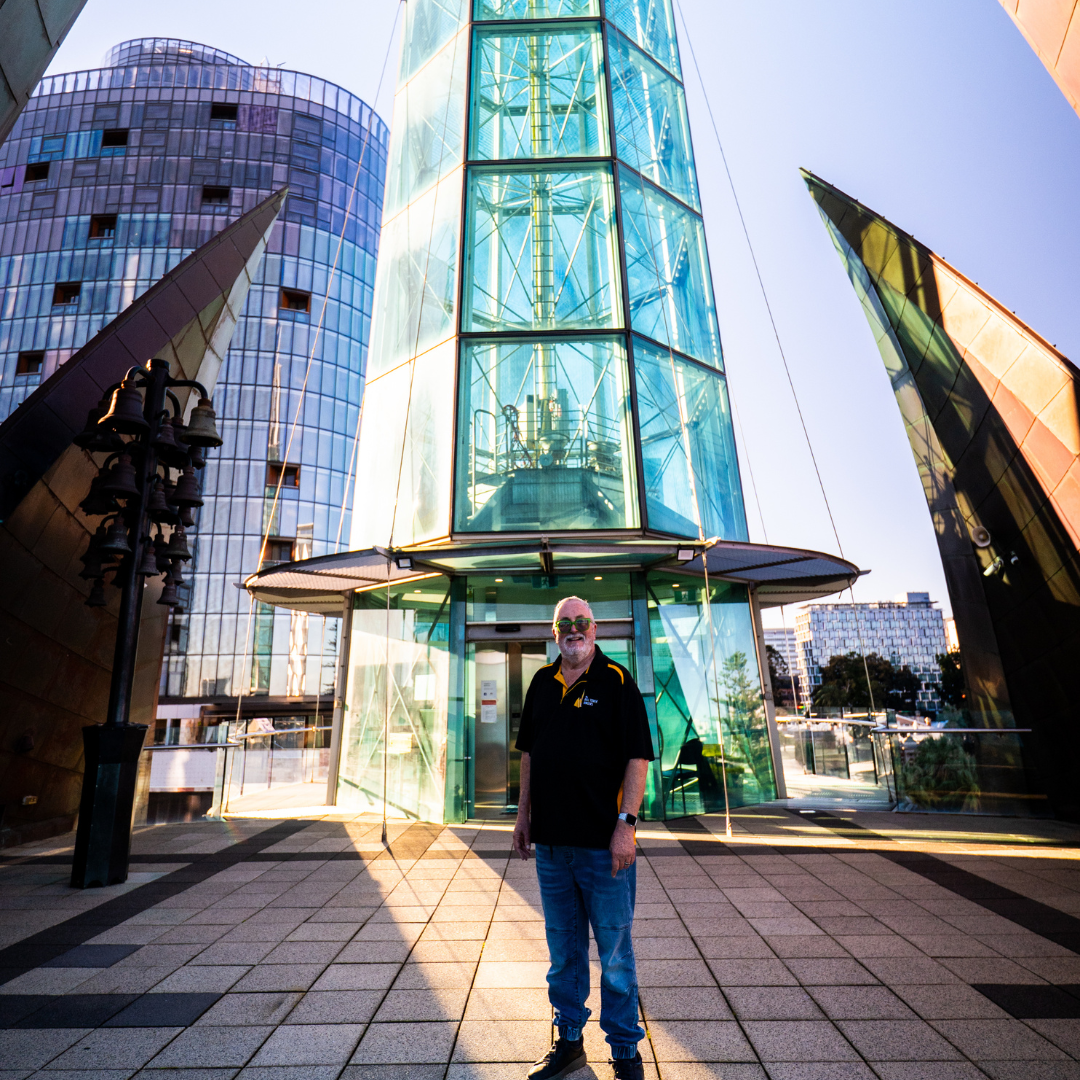
Hi Tony, you've spent many years at The Bell Tower. How did you first get involved?
I've been involved with The Bell Tower since it opened in 2000. Before that, I'd been a bell ringer since I was 12 years old. When The Bell Tower opened in 2000, they wanted to get as many bell ringers as they could in Perth together to ring the bells, because it was a new installation of 16 bells, which is quite unusual and quite a lot. So, I came along on the day they tried the bells out. The tower was still partly covered in scaffolding, there was sand all around us, and we had to wear hard hats. I rang the bells for the first time towards the end of 2000, so I've been ringing here at The Bell Tower ever since.
How does someone become a Bell Ringer?
I grew up in the south of England, as you can probably tell, and I was in a church choir. When I got to about 12 years old, my voice began to break and they said, "You can't sing in the choir anymore because you haven't got a lovely choirboy voice." They asked, "Would you like to learn to be a bell ringer instead?" I thought that sounded interesting. I'd seen the bell ringers through the door sometimes and it always looked quite fun, so I learned to be a bell ringer. It grabbed me and I've loved doing it ever since.
The Bell Tower turned 25 last year. Do you have any favourite moments from that time?
For me, it's always been wonderful meeting the people who come to visit the tower on tours and showing them something they knew nothing about before they walked in. I often say to visitors that if they don't know anything about bells when they arrive, they'll know a little bit more by the time I've finished talking.
One of the highlights is letting people have a go at chiming the bells. You just can't do that anywhere else. You can't walk into a church or cathedral and have a go ringing the bells, but here we let visitors chime them.
Seeing people's faces light up when they realise they've got control of a 250-kilogram bell above them is wonderful. People absolutely love it, and I get a lot of enjoyment from seeing how happy they are after visiting The Bell Tower.
What is it about The Bell Tower that has kept you so passionate all these years?
That's a good question. I don't know really, I just feel like I'm part of the place now. It's virtually in my system, in my blood. I come here two, three or four times a week, either to ring the bells or to be a tour guide. I just love being here.
xxxx
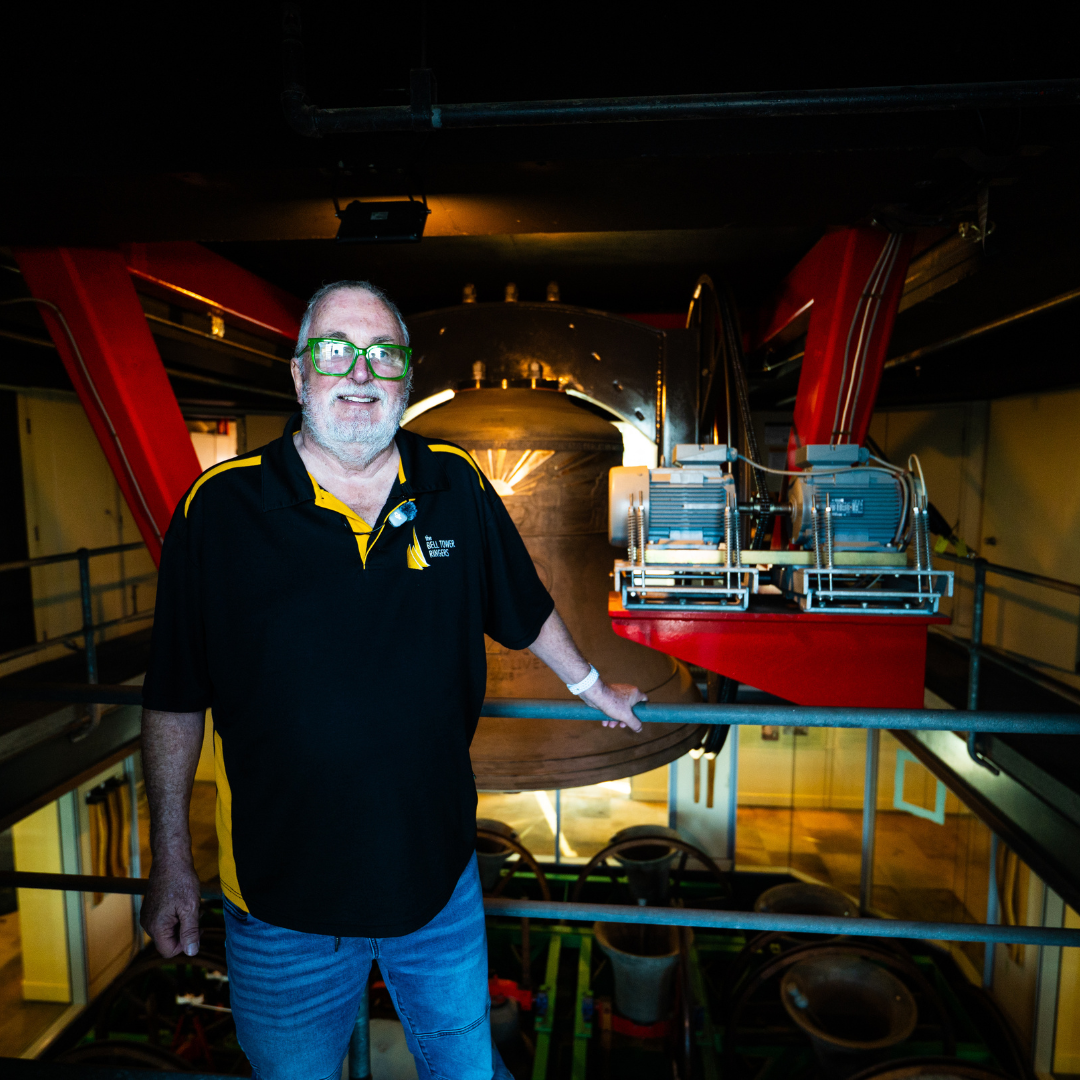
The bells themselves have travelled a long way to get here. Can you tell us a bit about their journey from London to Perth?
The history of the bells is fascinating. They were made in 1725 and rang in the church of St Martin-in-the-Fields in London right through until 1987. In 1987, it was discovered that the tower was beginning to crack because of the movement of the heavy bells, so they wanted to take them out and make smaller bells instead. To do that, they would have had to break these bells up, melt them down and make new ones.
But a businessman from Perth, Leith Reynolds, who was very keen on bells, discovered this plan and thought, "What a waste."
He organised a deal with the authorities in London that they would donate the bells to Perth for Australia's Bicentenary in 1988. In return, he persuaded mining companies in Australia to donate copper and tin to make the bronze for the new bells in London.
So London got the new metal and we got the old bells. The bells came out to Perth in 1988, but there was nowhere to put them. The Bell Tower wasn't built until 2000, so they had to sit in a warehouse for 12 years.
Anyone who was around Perth in the late 1990s will remember the huge controversy surrounding the construction of The Bell Tower. People said it would be a white elephant, and no one would want to visit it. Well, now it's one of Western Australia's top tourist attractions, and we're very proud of it.
You've been telling The Bell Tower's stories for years. What’s one of your favourites?
The tenor bell is probably my favourite story. The tenor bell weighs one and a half tonnes, about the same as a medium-sized car. It's the bell right in the middle of the ring and it's the only bell that has a name. It's called Zachariah.
It was named after the vicar of the church in 1725 when the bells were installed. His name was Dr Zechariah Pearce.
I like that story because Pearce is actually my family name, and I like to think Zechariah Pearce was probably a fairly big guy, because they named the biggest bell after him. Maybe I'm some sort of descendant of his because I'm a big guy too.
The Bell Tower has developed a few legends over the years. One of the most famous is 'Noisy Jack'. What's the story there?
Noisy Jack comes from a children's book written by a local author a few years ago. It's a story about what happened to the bells and how they came to be here, and also a story about events before the bells were sent to Perth.
It's just a children's story, but it's become something of a legend. Children read the book and often ask questions about Noisy Jack when they visit.
It's not really based on any knowledge that bell ringers have — it comes from the book. It's quite a gruesome story, which of course children tend to enjoy.
Are there any moments in the bells' history that stand out?
The bells rang for Sunday services and weddings at St Martin-in-the-Fields from 1725 to 1988. They also rang for royal occasions from the time of King George II right through to King Charles III. They've rung for every coronation of an English monarch from George II onwards.
What's remarkable is that when King Charles III was crowned, the bells were ringing here in Perth, not in London. They still rang for his coronation, continuing that connection with the Royal Family.
If you could go back and witness one moment from the bells' history, what would it be and why?
I'd love to see the bell ringers ringing these bells back in 1725 and see what it was like.
They rang them in essentially the same way we do today, but it was a much harder job in those days because the bells weren't mounted on the fittings we have now.
Bell ringers tended to be young men, and bell ringing was often used as a form of exercise. They didn't go to gyms or play organised sport the way people do today.
I'd love to see those bells being rung in 1725 and know that today we're still ringing exactly the same bells. Three hundred years later, they sound the same as they did back then. That's something really special.