Kensington - FAQs - Demolition Works
The Kensington site presents a significant opportunity to transform surplus government land into a connected, mixed-use precinct that supports housing supply, jobs, research and innovation, while retaining the site's valued landscape character.
As DPIRD operations are progressively relocated, demolition, remediation and site preparation works will be undertaken in stages to enable future redevelopment.
Demolition is occurring within the Tranche 1 area and consists of experimental plots and unused, unoccupied buildings at the Kensington site, where DPIRD offices and facilities currently reside.
Demolition is an early step to enable the progressive redevelopment of the site. It will also reduce risks associated with vacant or deteriorating buildings, minimise ongoing maintenance and management obligations for DPIRD, and assist in the ongoing management of asbestos and other safety-related risks across the site.
The demolition works include the removal of unused buildings to slab level.
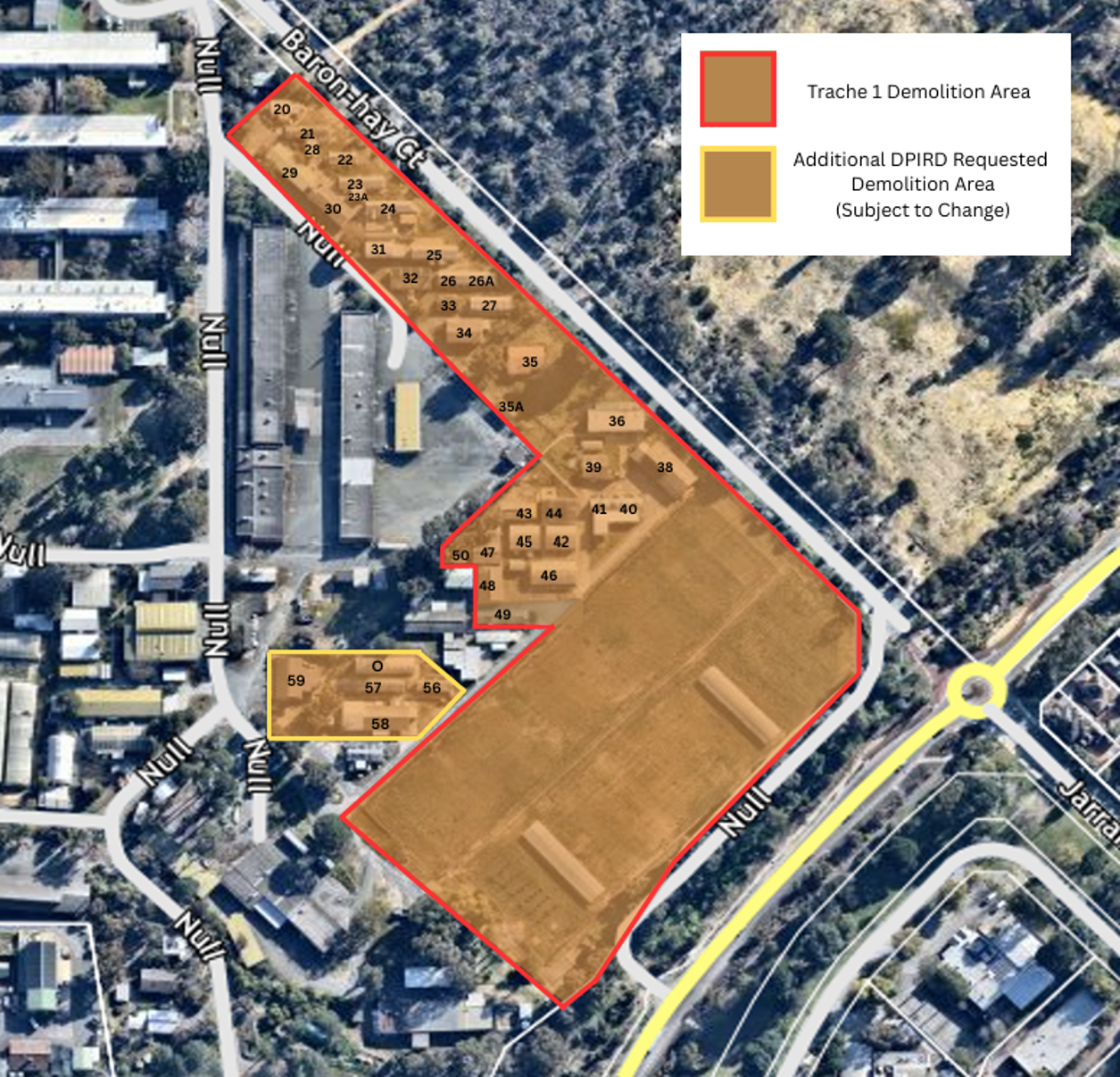
Demolition of unused buildings within the Tranche 1 area commenced in September 2026 and is anticipated to be completed by November 2026.
Further demolition, remediation and site preparation are expected to be undertaken in stages throughout 2027, subject to DPIRD's operational requirements and planning approval.
DevelopmentWA is responsible for managing the redevelopment planning and works, including coordination of demolition.
Demolition approval from the City of South Perth was obtained by the demolition contractor prior to works commencing. A statutory notification has also been submitted to WorkSafe Western Australia.
The work areas will be securely fenced, with clear signage in place. Existing and temporary fencing will be used to clearly demarcate construction areas and restrict unauthorised access.
Hazardous materials surveys, including building inspections, material sampling and laboratory analysis, have been completed across the Tranche 1 area to identify potential hazards, including asbestos-containing materials.
The investigations identified asbestos-containing materials in several buildings, which is consistent with the age and construction era of the site. Both friable and non-friable asbestos-containing materials were identified.
The survey findings have informed the demolition methodology and asbestos management approach. All identified asbestos-containing materials will be removed by appropriately licensed contractors in accordance with an approved Asbestos Removal Control Plan and relevant work health and safety legislation.
Hazardous materials surveys and sampling have identified asbestos-containing materials within some of the buildings, which is consistent with the age and construction era of the site.
All asbestos removal and demolition works will be undertaken by appropriately licensed contractors in accordance with relevant legislation, regulations and approved management procedures.
Asbestos removal will be carried out in accordance with a site-specific Asbestos Removal Control Plan and relevant work health and safety legislation, regulations and codes of practice.
Control measures will be tailored to the specific building or structure being demolished and the type, condition and location of any asbestos-containing materials identified. Measures may include exclusion zones, sealed asbestos waste bins, wet removal methods and decontamination facilities.
Independent occupational hygiene consultant Tetra Tech Coffey will undertake air monitoring and asbestos clearance inspections throughout the works. Clearance certificates will be issued before structural demolition commences.
Buildings will be stripped of fixtures, furniture, equipment and hazardous materials before demolition commences.
Dust suppression measures will be implemented throughout the demolition works to minimise impacts on neighbouring properties and site users. Measures will be tailored to the specific demolition activities and site conditions and may include water carts and reticulation systems, active wetting down of work areas and stockpiled materials, monitoring of wind conditions and covering truck loads prior to leaving site.
Independent environmental monitoring will be undertaken throughout the works to verify the effectiveness of dust suppression measures and compliance with relevant regulatory requirements and approved management plans.
Some noise and vibration is inevitable during demolition works; however, activities will be planned and managed to minimise impacts wherever reasonably practicable. Contractors will be required to implement appropriate mitigation measures and use the quietest reasonably practicable equipment and methods.
Noise and vibration levels will be managed in accordance with applicable work health and safety legislation and environmental requirements. Independent monitoring will be undertaken by RPS and Tetra Tech Coffey to verify compliance with relevant limits, approved management plans and contractor obligations.
Project-specific trigger levels will be set below the applicable statutory and health-based limits to enable mitigation measures and corrective actions to be implemented in advance of any exceedance of regulatory thresholds.
To minimise impacts on DPIRD operations, the contractor will establish a dedicated site access point for light vehicles from Baron-Hay Court and will not use the existing entry.
Heavy vehicle and truck movements associated with demolition works will be managed separately, with access to and from the Tranche 1 area primarily via Kent Street.
Work hours will comply with authority approvals. Typically, construction activities are undertaken between 7.00 am and 5.00 pm, Monday to Saturday.
A full site services survey is scheduled to identify the location and extent of existing services across the site. This information will be used to enable buildings within the Tranche 1 area to be safely isolated and disconnected while maintaining services to retained buildings and ongoing DPIRD operations wherever possible.
Service disconnections will be carefully planned and coordinated with DPIRD to avoid disruption to ongoing operations wherever reasonably practicable.
Access to buildings retained within the Tranche 1 area may be temporarily restricted during demolition works to ensure the safety of site users and contractors. Any affected staff and building occupants will be consulted in advance of works commencing.
